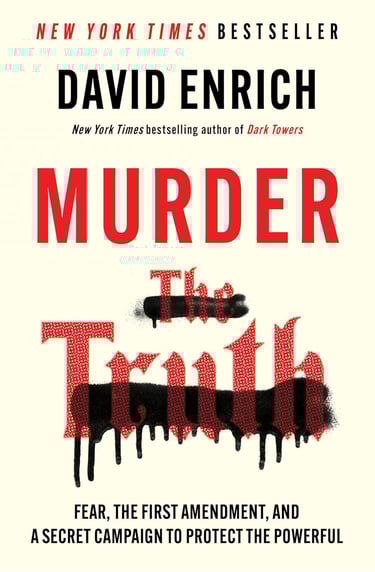
“For the next half century, even as American politics grew increasingly polarized, there was remarkably broad agreement that the Supreme Court had gotten this right. Its string of libel decisions–beginning with its unanimous 1964 ruling in New York Times Company v. Sullivan–was generally regarded with reverence. As recently as 2010, Congress passed a law celebrating the country’s commitment to defending Americans from weaponized libel claims. In a barely recognizable act of bipartisan unity, not a single lawmaker voted against the legislation. And then, in the space of only a few years, that consensus crumbled. Donald Trump was a crucial catalyst. Beginning in 2016 and continuing through 2024, he relentlessly demonized the media as ‘evil,’ ‘criminals,’ and the ‘enemy of the people,’ applauding violence, threatening to revoke TV networks’ licenses, and floating the idea of jailing reporters. There is a long history, of course, of politicians attacking the news media. He convinced broad swaths of the public that journalism itself was illegitimate, that its articles, fact checks, and exposes were not to be trusted–a belief that was enhanced at times by some journalists shirking their roles as open-minded seekers of truth instead donning the robes of ideologies. As this distrust took root among millions of Americans, it would become much easier to justify the curtailment of long-standing press freedoms and for politicians, business executives, and others to escape accountability. But more subtle forces were also at play, including the emergence of a clique of high-powered lawyers who, motivated by a mixture of profits and politics, specialized in attacking journalists and others on behalf of Russian oligarchs, opioid-pushing executives, corrupt politicians, scandal-plagued celebrities, and many others who were the subjects of unfavorable media coverage.”
Murder the Truth by David Enrich - 2025
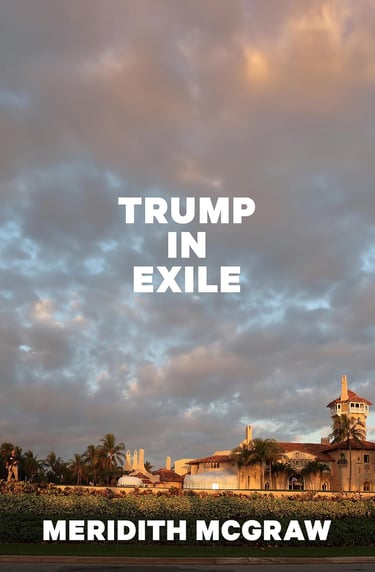
Trump in Exile by Meridith McGraw - 2024
91
92
“Campaign Monitor, an email marketing platform, had been the primary distribution engine for Trump’s fundraising emails but had suspended the Trump operation after January 6. And major donors, like Marriott, were no longer interested in giving to the GOP. But issues with email lists and corporate snubs aside, Trump was still the star attraction for major fundraisers at Mar-a-Lago. Make America Great Again Action, a super PAC run by Corey Lewandowski, former Florida attorney general Pam Bondi, and Dave Bossie, held a fundraiser at Trump’s New Jersey golf club at the end of May for which ticket prices started at $250,000. In the PAC’s first two months it took in more than $3 million from major Republicans donors like Don Ahern, a Nevada businessman who gave $1 million; Kelly Loeffler, the wealthy former Georgia senator who had lost her seat to Raphael Warnock in a runoff election; and MyPillow CEO Mike Lindell. By the end of June, Trump and his political action committees had amassed a war chest of more than $100 million – an unprecedented amount of money (especially for a defeated ex-president) that rivaled the Republican National Committee and the GOP’s House and Senate campaign committees. Much of that money was raised off Trump’s false claims that the election was stolen, that he needed money to support the audits in Arizona and other states, and his promise to support MAGA candidates in the 2022 midterms. In a statement about his fundraising Trump thanked the donors who ‘share my outrage and want me to continue to fight for the truth.’ Trump’s fundraising success in the first six months after being forced from office was a proof of concept that falsehoods about the election were now baked in and had become the new Republican ‘truth.’ And it was very on-brand that Trump did not share the wealth. During that six-month period, none of the funds raised by Trump’s PAC had gone to any of the audit efforts or boosting any of the candidates Trump had endorsed. Millions instead were spent on political advisers, events, travel, more fundraising outreach, and legal fees for attorneys who had defended Trump in his second impeachment trial. Trump was squirreling away money – and political capital in the form of endorsements – to put toward his next act.”
“On the morning of March 21, three days after the Gawker verdict and hours before jurors awarded the additional $25 million in damages, (Trump) had arrived at the Washington Post’s headquarters for an hour-long interview with the newspaper’s editorial board. The discussion started with Trump bragging about how his planned hotel on Pennsylvania Avenue was ahead of schedule and under budget. Then it veered into foreign policy. Eventually the Post’s publisher, Fred Ryan, piped up. ‘You’ve mentioned that you want to ‘open up’ the libel laws. You’ve said that several times.’ ‘I might not have to, based on Gawker, right?’ Trump interrupted. ‘That was amazing.’ ‘What presidential powers and executive actions would you take to open up the libel laws?’ Ryan asked. Trump launched into a soliloquy about how the press treated him unfairly. Ryan tried again. ‘But how would you fix that?’ he asked. Trump wouldn’t be pinned down, even as other Post journalists asked him increasingly specific questions about New York Times v. Sullivan and the actual malice standard.”
“Trump was most upset about the uptick in praise for and interest in DeSantis, though, blasting him for being ‘disloyal’ and accusing him of being cute about his presidential ambitions. . .‘Ron came to me in desperate shape in 2017 – he was politically dead, losing in a landslide to a very good Agriculture Commissioner, Adam Putnam, who was loaded up with cash and great poll numbers. Ron had low approval, bad polls, and no money, but he said that if I would Endorse him, he could win. I didn’t know Adam so I said, ‘Let’s give it a shot, Ron.’ When I Endorsed him, it was as though, to use a bad term, a nuclear weapon went off. Years later, they were the exact words Adam Putnam used in describing Ron’s Endorsement. He said, ‘I went to having it made, with no competition, to immediately getting absolutely clobbered after your Endorsement.’ I then got Ron by the ‘Star’ of the Democrat Party, Andrew Gillum. . . , by having two massive Rallies with tens of thousands of people at each one. I also fixed his campaign, which had completely fallen apart. I was all in for Ron, and he beat Gillum, but after the Race, when votes were being stolen by the corrupt Election process in Broward County, and Ron was going down ten thousand votes a day, along with now-Senator Rick Scott, I sent in the FBI and the U.S. Attorneys, and the ballot theft immediately ended, just prior to them running out of the votes necessary to win. I stopped his Election from being stolen. . . And now, Ron DeSanctimonious is playing games! The Fake News asks him if he’s going to run if President Trump runs, and he says, ‘I’m only focused on the Governor’s race, I’m not looking into the future.’ Well in terms of loyalty and class that’s really not the right answer.’”
93
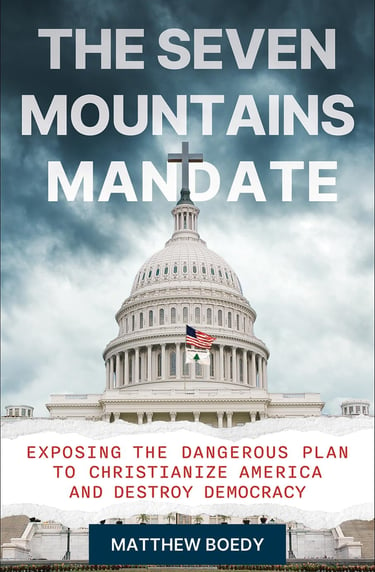
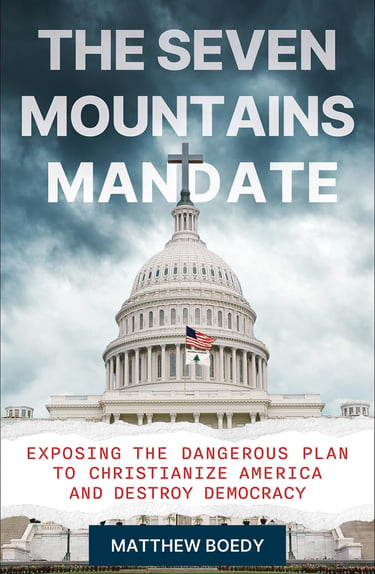
“In his most explicit work, (Francis) Schaeffer wrote in A Christian Manifesto that America was being destroyed by tyranny. In the words of one biographer, ‘Schaeffer saw only two alternatives for American culture: either society would return to its Christian base, or there would be an imposed order.’ While Schaeffer advocated for Christians to resist tyranny, he demurred when asked for specifics. Because Schaeffer was committed theologically to a view of the end-times that predicted social chaos and persecution of Christians, he not only didn’t see any form of theocracy arising, but he didn’t want it. Yet for the movement today, Schaeffer is a prophet. For example, William Wolfe, author of the 2022 book The Case for Christian Nationalism, wrote that the ‘rapidly metastasizing vision of government’ as ‘the state’ as an all-controlling entity akin to governments in non-democratic countries is ‘at the root of our peril and predicament.’ He adds in the next line that Schaeffer ‘saw it coming.’ Another supporter of Christian nationalism, Pastor Douglas Wilson, who oversees a multi-institutional operation in Moscow, Idaho, wrote that the American government had ‘declared war on righteousness itself’ in the last few decades. Wilson stops short of leading a revolution, though he is clear on what the outcome should be for the ‘war’ he described: ‘We are simply calling upon God to destroy His enemies. Our first preference is that He destroy them by transforming them into His friends. . . But if their hearts are hardened, we call upon God to take them out nonetheless.’ Because of this type of language, the question of violence is always at the forefront. One reviewer of Wolfe’s book put it clearly: ‘His use of Christian language to defend political violence against a freely elected government should be a bigger scandal than it is: It amounts to a call for holy war against democracy.’ This rhetoric has a real impact. Christian nationalism was a major theme for those who participated in the 2021 insurrection and its related anti-democracy scheme, ‘Stop the steal.’ Not surprisingly, the mandate movement’s spiritual warfare has translated well into Donald Trump’s authoritarian political vision. Supporters of the seven mountains mandate have been widely supportive of Trump. And it doesn’t matter to the movement that Trump isn’t spiritual in practice nor does he act overtly like a Christian. He has been hailed as a modern Cyrus, the sixth-century Persian king who ended the Babylonian captivity and is referenced as a figure of Jewish deliverance. As Matthew Taylor points in his 2024 book about the spiritual warfare that supported the 2021 insurrection, ‘a leader in one of the nonreligion mountains doesn’t have to be pious or even necessarily religious to govern according to the kingdom of God. They just have to exert their power in conformity with’ the interests of conservative Christians.”
The Seven Mountains Mandate by Matthew Boedy - 2025
“The jokes give him cover. Through them, our insult comic-in-chief reserves the right, always, to be kidding–even about matters of life and death. Does the president, in general . . . mean it? Do we take him at his word? The answer, despite all that hinges on the questions, is most often a resounding ‘maybe.’ When cribbing from the infamous scripts, he describes ‘the enemy from within’-- or when he muses about police forces fighting back against criminals for ‘one real rough, nasty day,’ or talks about becoming ‘a dictator’ – you could read each as a direct threat. You could assume that he’s embellishing, teasing, trolling. You could assume the position of the pundit, telling yourself and everyone else that he should be taking ‘seriously, but not literally.’ You could try your best, knowing all that is at stake, to parse all the words that fail as language. The need for translation, itself, is a concession. The constant uncertainty– about the gravest of matters– is one of the ways that the president keeps people in his thrall. Clear language is a basic form of kindness: It considers the other person. It wants to be understood. Muddled language typically wants the opposite. The scripts that rise from it tend to fail at the script’s most basic task: They have no hope of bringing people together.”
The Man who Sold America by Joy Reid - 2019
“(Charlie) Kirk adds to that ideal an appeal to undermine the very Constitution he claims to honor. Kirk said in 2022 that the U.S. Constitution is only fit for a moral and religious people, paraphrasing a 1798 letter written by John Adams. That letter was Adams’s justification to the Massachusetts militia for the empowering of a Christian government against the same kind of moral rot Kirk and the seven mountains mandate movement fear today. One historian called the justification by Adams ‘an extraconstitutional means of controlling the kinds of unbridled human passions that, in Adams’ view, the Constitution alone could not control.’ Many experts think Trump is the next one to try to implement that extraconstitutional control.”


94
“Trump also told people that every time he had started running for president–in 1988, 2000, and 2012–the money started pouring in. He claimed he’d ‘made a fortune on the birther stuff,’ which piqued the interest of billionaire cranks who suddenly took interest in him. It wasn’t clear whether Trump actually believed the conspiracy theory questioning Barack Obama’s birthplace, though his antipathy for, and some would say of envy of and obsession with, Obama was never in doubt. During the early months of the campaign, the Republican operative said, Trump told him and a U.S. senator who later became a fellow supporter of the president that his presidential bid would be a marketing boon to his newest hotel, the Trump International Hotel in Washington, D.C. ‘I’ll run for president for a few months and get a bunch of publicity and boost the room rates,’ the operative says Trump explained. ‘You can’t buy that kind of publicity, and when you run for president, you get it for free.’”
“‘What’s different about the Republicans now under Trump,’ said Tom Nichols, ‘is that they are a party of negative aims rather than positive goals. It’s just about tearing down instead of building. There is this resentment and I think a part of it has to do with the fact that the information age has created a chasm that’s getting wider between the people who can live in the 21st century and people who just can’t deal with it; who don’t have the skills. They’re kind of the buggy whip manufacturers of the modern era. They can’t deal with diversity. And so what they want in that ‘Freedom Caucus’ is, as long as I make you miserable, that’s my metric that I’m doing the right thing, because I don’t really have my own goals and I can only judge my performance on how angry you seem to be.’ . . . (Senator Leslie) Graham had voiced a Nicholsian truth: that his party increasingly the redoubt of white Christian men (and many of their wives), whose anger and desire to make those they deemed their adversaries uncomfortable was based on a real thing, fear of the consequences of demographic, social, and political decline. With Trump pushing the pressure points of his party to the breaking point, and the demographic train barreling down the station toward a midcentury that will look quite different for white America, a question remained about what the party would be after it no longer had him as its standard-bearer. Would the GOP simply go back to what it was, sublimating the pockets of genuine anger and fear among the base, that Trumpism unearthed, so that the pyramid could right itself again? Or would the party’s now-captive elite discover that the monster it unleashed over the decades from the Southern Strategy to the Tea Party to Donald Trump simply could not be forced back into its cage?”


Comply with Me: Trump’s Hypnosis Toolkit Exposed by Lisa Morgan - 2020
96
“And where Barr parsed Mueller’s findings to find only the most exculpatory ones, the actual conclusions in the report were damning. The report found ten distinct instances of potential obstruction of justice, including Trump pressuring James Comey to end the investigation of General Michael Flynn, Trump’s pressuring of cabinet members to publicly deny he had any connections to Russian interference, the firing of Comey and Trump’s attempts to force his subordinates to remove the special counsel, and the editing of Donald Jr.’s press statements, encouraging Michael Cohen to not cooperate with the Mueller probe and attempts to hide information from the public. Mueller’s report concluded that only the refusal by members of Trump’s administration, including the White House counsel to accede to his demands, prevented Trump from succeeding in carrying out that obstruction.”
Screen People by Megan Garber - 2026
95


“It was the handshake that betrayed him, a clue so obvious that I couldn’t believe the media hadn’t picked up on it. Much discussion in newspapers and online, Donald Trump’s handshake has been nicknamed the Trump Pump and the Bone Crusher. Typically, it involves a strong-armed pull-push and takes considerable seconds to complete. As soon as he is within arm’s length, Trump jerks his prey towards him, grasping their fingers hard while pulling them off balance. He follows through with a forceful push, causing the other to step backwards in surprise. Analysts have explained these greetings as power moves, viewing them as a method for Trump to assert his authority. Yet they are subtler than they appear and more effective than commentators realize. His handshake routines aren’t identical. He rings the changes. Sometimes he pats the back of the person’s hand, he might give them a jerk sideways, or his left arm might extend to pull the person’s right shoulder nearer towards him. . . Trump’s handshake routine is not original. It is a classic confusion procedure aimed at putting people in a trance quickly. I spotted it immediately because I teach it. Developed by hypnotherapist, Milton Erickson, it became popular, along with other Ericksonian techniques in the 1970s and ‘80s. He found fame for the way he could talk people into a trance, and back to health, using stories full of subtle suggestions which they absorbed unconsciously. Erickson loved creating confusion and even shocking his clients into a hypnotic trance. He used a handshake to put people into a trance as soon as they came into the consulting room. He would interrupt the shake in an unexpected way, befuddling them. Their guard would drop, their brain would ‘freeze’ and then they would go into a brief trance, which Erickson would deepen by suggesting they relax further. He did this either through encouraging movements such as lowering his eyes or through carefully chosen words. Erickson described his handshake technique in detail in a written letter to one of his friends. He explained that he began a handshake in the normal way and then give a gentle touch of the thumb, a lingering drawing away of the little finger; a faint brushing of the subject’s hands with the middle finger moving the attention of the person so they lingered on the handshake. . . The key is to shake someone’s hand and then break the expected routine by doing something different. The person whose hand you are shaking becomes confused and disorientated for a moment. . . There are several examples of this technique in action that give some clues to how (Trump) is planting suggestions. Seconds after Trump held Theresa May’s hand, he told her that they would have ‘a very special relationship’ and that he thought they ‘would get along very well’. Innocuous stuff you might think, but successful hypnotic suggestions are vague. If May had been the receiver of the Trump handshake-interrupt, those statements from Trump would have bypassed her critical faculty and been absorbed by her unconscious mind without question. She would have found herself thinking warmly of Donald Trump, despite any inner misgivings, and perhaps experiencing a vague discomfort, (what is known as cognitive dissonance) if, later on, someone in her cabinet criticized him. At their first meeting at the White House, Shinzo Abe, Prime Minister of Japan was reported to be ‘visibly bewildered’ as he endured a nineteen second bone crushing Trump handshake. Though it might seem more difficult for Trump to embed a suggestion in someone who does not speak English, I discovered from ten years working in Asia that hypnotic suggestion works well in the context of simultaneous or consecutive translation. Sometimes this can be even more effective as the message goes in through two channels of understanding. The language needs to be simple, just like Trump’s. As the handshake ended, he announced: ‘Strong hands,’ which was straightaway translated. On the surface of it, this is a compliment to the strength of the Japanese Prime Minister’s grip. But consider it as a concept to be planted into Abe’s unconscious mind. Now, lodged in his brain, lies an artfully vague suggestion concerning Trump. His unconscious mind needs to make sense of it and, as is the nature of the unconscious, it does so in a symbolic way. When Abe thinks of the US president, if Trump’s suggestion technique succeeded, he will find himself musing on how strong Trump is as a world leader. ‘Strong hands’ will have hit its mark.”
“Trump is an ad man above all: He understands, far better than those who allow themselves to be constrained by the fusty categories of truth and falsehood, that words can create new realities rather than merely reflecting the ones that were already there. Well before he applied the insight to politics, he exploited the insights that Daniel Boorstin and so many other critics had offered up as warnings. When fact and fiction blend, the words we rely on to help us discern the one from the other can lose their bearings, as well. They can come to operate the way the ‘unscripted’ scripts of reality TV do: They can destabilize things instead of clarifying them. They can put every claim–about politics, about the facts of the world, about other people–within invisible, indelible scare quotes. Trump understands how easily that slippage can occur. He understands that ‘the death of the author,’ as the French theorist Roland Barthes termed it, can come for language itself. He knows that words, released from the moorings of common truth, can mean whatever you say they mean–and whatever you want them to. The president’s louche approach to language is its own enduring source of instability and category collapse. It is also one of the ways that he keeps his audience tuned in to his show. You never know where the scripts will lead. You never know what new circumstances will be ad-libbed into existence. Trump does not merely star in our shared reality show. He serves, too, as the executive producer, the showrunner, the marketer, the writer, the casting director, the set designer, the judge. He absorbs the logic of his genre–the quick cuts, the villain edits, the teasing blend of fact and fiction–and reflects it back to his audience. Donald Trump is not here to make friends. He is here to make reality. The September before the 2024 election, both Trump and his running mate, J.D. Vance, spread lies claiming that Haitian immigrants in a small town in Ohio were stealing, and then eating, their neighbors’ pets. The stories were racist. They posed a direct danger to real people. When confronted about them, Trump took refuge in the familiar rebuttals (‘people are saying,’’The media are lying,’ etc) Vance, however, took a different tack. ‘The American media totally ignored this stuff until Donald Trump and I started talking about cat memes,’ he said in an interview. ‘If I have to create stories so that the American media actually pays attention to the suffering of the American people, then that’s what I’m going to do.’”